
Helped Clients Recover Over $25 Billion. Since 1979.
Trademarks, copyrights, and patents all protect intellectual property, but they cover very different things. Trademarks protect your brand identity (names, logos, slogans). Copyrights protect original creative works (writing, art, music, software code). Patents protect inventions and functional innovations. Many businesses need more than one type of protection, and choosing the right combination depends on what you’ve created and how you plan to use it.
If you’re a business owner, you’ve probably heard that you need to “protect your intellectual property.” But when you start researching, you quickly encounter three different terms: trademarks, copyrights, and patents. What’s the difference? And which one do you actually need?
The short answer is that each type of intellectual property (IP) protection covers something different. Trademarks protect your brand identity. Copyrights protect creative works. Patents protect inventions. Many businesses need more than one type of protection, and choosing the wrong one (or skipping protection entirely) can leave your most valuable assets vulnerable.
This guide will walk you through exactly what each type of IP protects, provide real-world examples across different industries, and help you determine which protections your business needs. If you have questions about trademark registration or copyright protection, contact our business law team for a consultation.
A trademark protects words, phrases, symbols, logos, and other identifiers that distinguish your goods or services from those of competitors. When consumers see your trademark, they should immediately associate it with your business and the quality you provide.
Examples of trademarks include:
Trademark rights in the United States are based on use. You acquire some rights simply by using a mark in commerce. However, federal trademark registration with the USPTO provides significant additional benefits, including nationwide priority, the legal presumption of ownership, and the ability to bring infringement claims in federal court.
Duration: Trademark registrations last indefinitely, as long as you continue using the mark and file required maintenance documents with the USPTO.
Registered with: United States Patent and Trademark Office (USPTO)
Copyright protects original works of authorship that are fixed in a tangible medium of expression. This includes a wide range of creative output, from written materials to visual art to software code.
Examples of copyrightable works include:
Copyright protection arises automatically the moment you create an original work and fix it in tangible form (write it down, record it, save the file). However, registration with the U.S. Copyright Office provides important advantages: you cannot file an infringement lawsuit until you register, and timely registration makes you eligible for statutory damages and attorney’s fees.
Duration: For works created today, copyright lasts for the life of the author plus 70 years. For works made for hire (created by employees within the scope of employment or under certain contractor agreements), protection lasts 95 years from publication or 120 years from creation, whichever is shorter.
Registered with: U.S. Copyright Office (a division of the Library of Congress)
Patents protect new, useful, and non-obvious inventions. A patent gives the inventor the exclusive right to make, use, sell, and import the invention for a limited period.
There are three types of patents:
Examples of patentable inventions include:
Unlike trademarks and copyrights, patents require a formal application and examination process. The USPTO reviews patent applications to determine whether the invention meets the legal requirements for patentability. This process is complex, typically takes two to four years, and generally requires the assistance of a registered patent attorney or patent agent.
Duration: Utility patents last 20 years from the filing date. Design patents last 15 years from the grant date.
Registered with: United States Patent and Trademark Office (USPTO)
Note: The Schenk Law Firm handles trademark and copyright matters. For patent applications, we can provide referrals to qualified patent counsel through our attorney referral network.
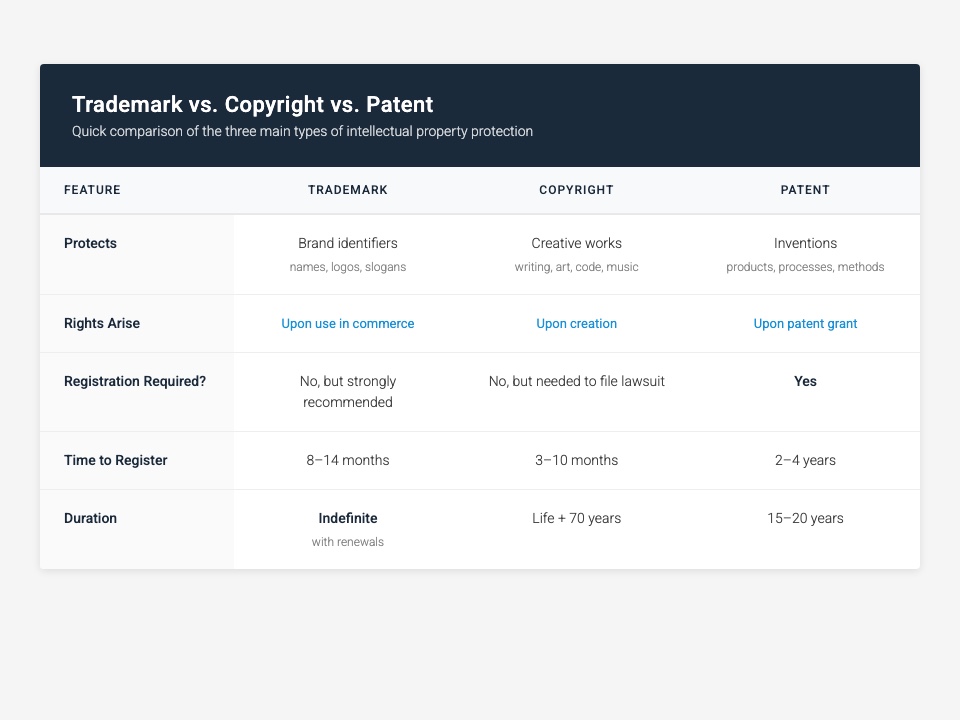
Understanding which IP protections apply to your business becomes clearer with concrete examples. Below are common scenarios for different types of businesses.
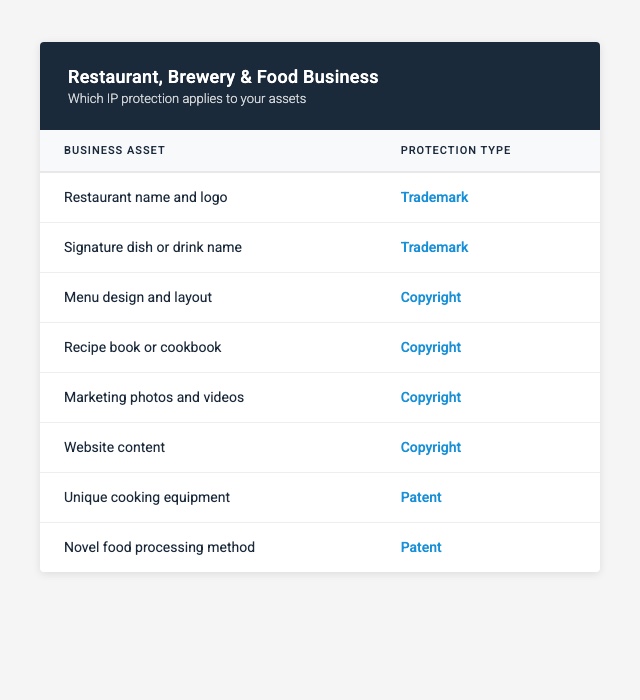
Example: A craft brewery should consider trademark protection for its brewery name, logo, and signature beer names. The original artwork on its labels would be protected by copyright. If the brewery invented a new brewing apparatus, that could potentially be patented.
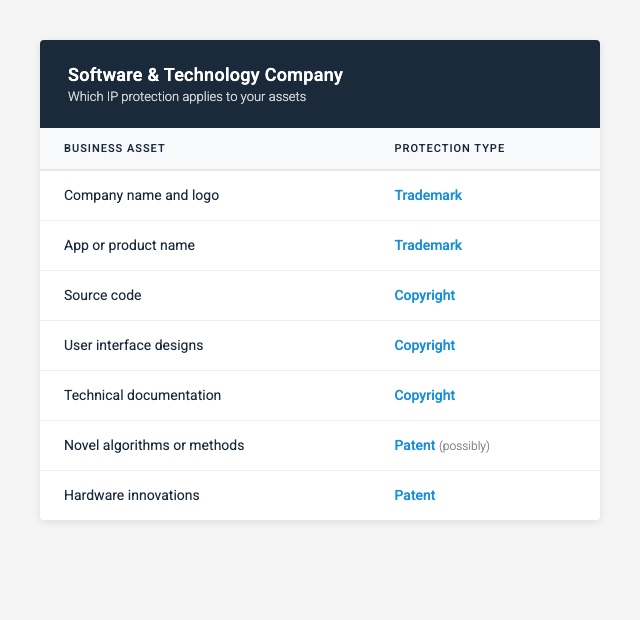
Example: A tech startup building a new app needs trademark registration for its company name and app name. The code itself is automatically protected by copyright (though registration may be advisable). If the app uses a genuinely novel technical process, patent protection might be worth exploring.
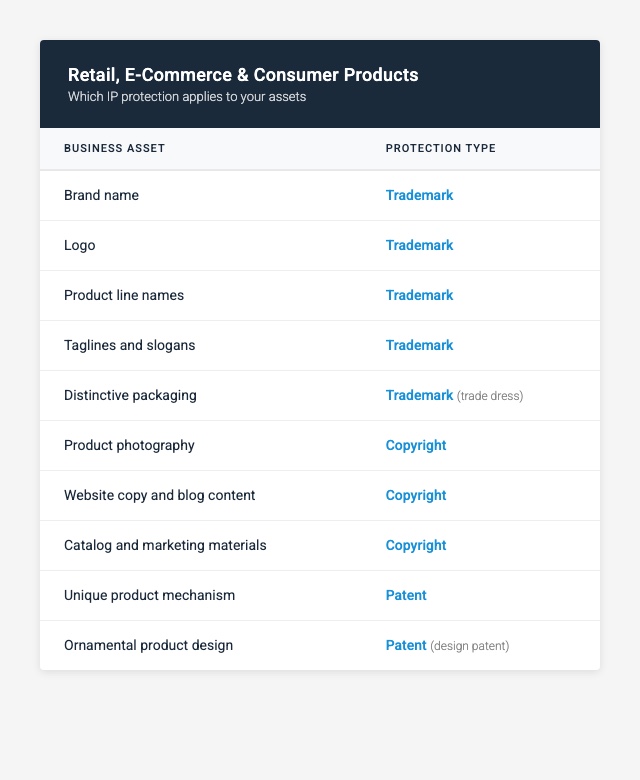
Example: An e-commerce brand selling on Amazon should prioritize trademark registration to qualify for Amazon Brand Registry, which provides tools to protect against counterfeiters. The brand’s product photos and listing copy are protected by copyright.
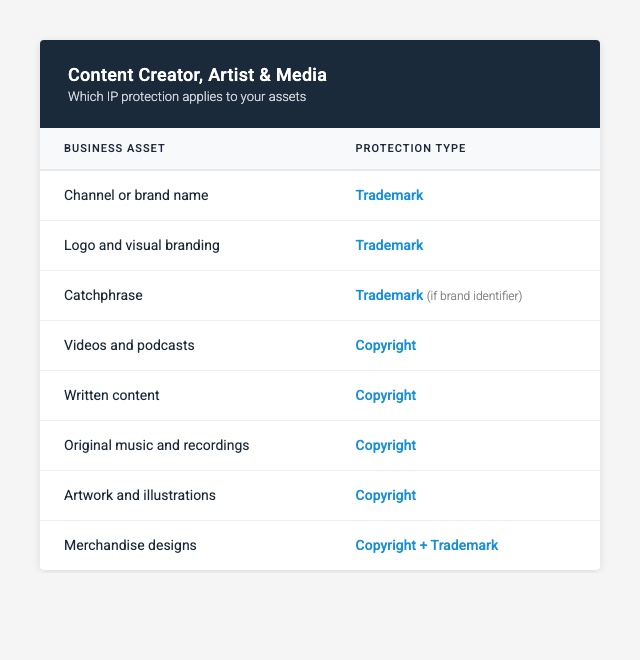
Example: A YouTuber or podcaster should consider trademark protection for their channel name and logo, especially before launching merchandise. All of their content (videos, scripts, original music) is protected by copyright, although registration with the United States Copyright Office may be recommended.
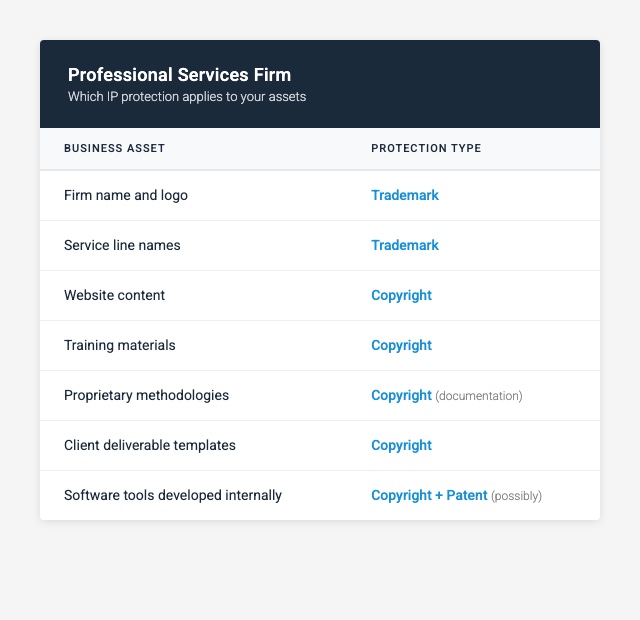
Example: A consulting firm or agency should consider trademark registration for its firm name. Written methodologies, training programs, and templates are protected by copyright. Consider including IP assignment clauses in your employment and contractor agreements to ensure the firm owns work created by team members.
Many businesses need more than one type of IP protection. Here’s how different protections can work together.
Example: Your Company Logo
Your company logo can be protected by both trademark and copyright:
Why does this matter? These protections serve different purposes and provide different remedies. Trademark protection focuses on preventing consumer confusion in the marketplace.
Copyright protection allows you to prevent unauthorized copying of the artwork, even by parties in unrelated industries.
When you work with a designer to create your logo, make sure your contract includes an assignment of copyright so your business owns the design outright.
Example: Software Products
Software products often benefit from multiple layers of protection:
For software companies, trademark registration is often the most important first step. Your brand is how customers find you and distinguish you from competitors.
Example: A Product-Based Business
A company selling physical products might need:
Based on his experience serving hundreds of business clients since 2005, David Lizerbram finds that most small and mid-sized businesses need:
Patent protection is relevant for businesses that have invented something genuinely new and useful, but this applies to a smaller subset of companies.
“I copyrighted my logo, so my brand is protected.”
This is a common misconception. Copyright protects the artistic design of your logo, but it doesn’t give you the right to stop competitors from using a similar name or logo in your industry. That’s what trademarks do. Similarly, registering a trademark doesn’t protect your website content or marketing materials from being copied.
In the United States, trademark rights are based on use, and the first party to use a mark in commerce generally has priority. However, federal registration provides nationwide constructive notice of your claim. If you wait years to register and another business starts using a similar mark in a different region, you may have limited ability to stop them.
The best time to pursue trademark registration is before you launch or as early as possible after you begin using your mark.
While copyright protection arises automatically when you create an original work, registration matters. Under U.S. law, you cannot file a copyright infringement lawsuit until your work is registered. More importantly, if you register before infringement occurs (or within three months of publication), you can seek statutory damages and attorney’s fees. This makes enforcement economically feasible for many cases that would otherwise be too expensive to pursue.
Forming an LLC or corporation with the California Secretary of State (or registering a fictitious business name) does not give you trademark rights. These are separate systems. Another business could potentially register your business name as a federal trademark, which could create significant problems. Entity formation and trademark registration should both be part of your business launch checklist.While copyright protection arises automatically when you create an original work, registration matters. Under U.S. law, you cannot file a copyright infringement lawsuit until your work is registered. More importantly, if you register before infringement occurs (or within three months of publication), you can seek statutory damages and attorney’s fees. This makes enforcement economically feasible for many cases that would otherwise be too expensive to pursue.
When you hire employees or independent contractors to create content, designs, code, or other creative work, who owns the IP? The answer depends on the relationship and the contract terms. Without proper agreements, you might not own work you paid for.
Make sure your contracts address intellectual property ownership, including work-for-hire provisions and IP assignment clauses where appropriate.
Intellectual property rights are territorial. A U.S. trademark registration provides only limited protection outside the United States. If you’re selling internationally (including through e-commerce platforms that ship globally), you may need to consider protection in other countries. David Lizerbram has experience managing international intellectual property portfolios and can advise on strategies for protecting your brand abroad.
Start with These Questions
Do you have a business name, product name, logo, or slogan?
→ You likely need trademark protection
Have you created original content, designs, software, or other creative works?
→ You have copyright protection automatically, but consider registration for valuable works
Have you invented a new product, process, or method?
→ Consult with a patent attorney to evaluate whether patent protection is appropriate
Do you have confidential business information that gives you a competitive advantage?
→ Consider trade secret protection through confidentiality agreements and security measures
A Practical Approach for Most Businesses
For most small and mid-sized businesses, we recommend this prioritized approach:
This approach protects your most visible and vulnerable assets first while building a comprehensive IP portfolio over time.
While this guide provides a general overview, intellectual property decisions have long-term consequences for your business. Consider consulting with an attorney when:
The ™ symbol indicates that you’re claiming trademark rights in a mark, regardless of whether it’s registered. Anyone can use ™. The ® symbol indicates that your mark is federally registered with the USPTO. Using ® when your mark is not registered is illegal and can create problems for your application.
It depends. Trademark rights are based on use in commerce, so the first user generally has priority. However, if the other user is in a completely different industry and there’s no likelihood of confusion, coexistence may be possible. A trademark clearance search can help evaluate the risks.
Registration is not required for copyright protection, but it’s required before you can file an infringement lawsuit, and timely registration makes you eligible for statutory damages and attorney’s fees. For valuable creative works, registration is generally worthwhile.
The current average timeline for a straightforward USPTO trademark application is approximately 12 to 14 months from filing to registration, assuming no legal issues arise. Applications that face Office Actions or oppositions take longer.
This page is for informational purposes only and does not constitute legal advice. Intellectual property law is complex, and the right strategy depends on your specific circumstances. Contact The Schenk Law Firm to discuss your business’s needs.