
Helping Clients in Orange County With E-Bike Accident Claims
E-Bike Accident Overview
Electric bicycles have become one of the fastest-growing forms of transportation in Orange County. Commuters, students, delivery riders, and families now use e-bikes daily on roads, bike lanes, and multi-use paths across cities like Irvine, Huntington Beach, Santa Ana, Anaheim, and Costa Mesa. But as adoption has surged, so have injuries. The U.S. Consumer Product Safety Commission (CPSC) reported an estimated 25,000 e-bike-related emergency department visits nationally in 2022 alone.
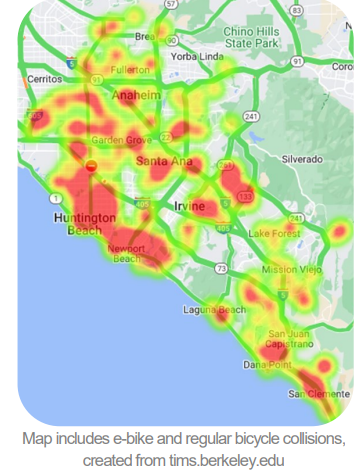
In Orange County specifically, Children’s Hospital of Orange County (CHOC) documented a staggering 1,557% increase in pediatric e-bike injuries between 2019 and 2024, rising from just 7 cases to 116. According to a national study led by CHOC, children and adolescents whose crashes were tied to losing control at high speeds were significantly more likely to sustain severe injuries, including head, neck, or facial injuries (49.1% vs. 28.7%), internal organ injuries (24.1% vs. 10.4%), and require hospital admission (7.3% vs. 4.7%). E-bikes are heavier, faster, and harder to stop than traditional bicycles, and the injuries they produce tend to be more severe.
Why Early Action Matters in Orange County
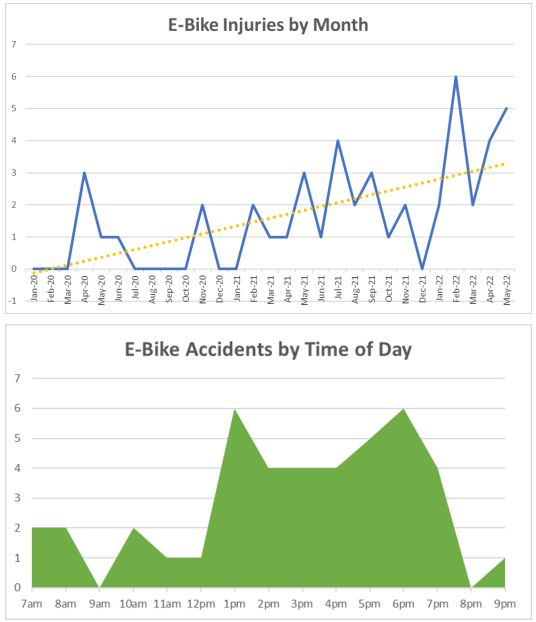
E-bike accident cases can be legally complex. California’s evolving e-bike regulations, including Senate Bill 1271 (effective 2025), create new questions about classification, compliance, and liability that didn’t exist a few years ago. Whether you were the e-bike rider struck by a negligent driver, a pedestrian hit by an e-bike, or a passenger in a vehicle involved in a collision with an e-bike, the evidence needed to build your case starts disappearing quickly.
Traffic camera footage, GPS and ride data, and vehicle damage patterns must all be preserved early. California’s two-year statute of limitations applies to personal injury claims, with a much shorter six-month deadline for claims involving government entities. Getting an attorney involved early protects both the evidence and your legal rights.
Common Causes of E-Bike Accident Incidents
- Distracted drivers. Among the most common e-bike accident scenarios in Orange County involve a motor vehicle driver who fails to see an e-bike rider. Texting, phone use, and GPS adjustments take a driver’s eyes off the road at exactly the wrong moment, especially in bike lanes and at intersections.
- Failure to yield. Drivers who fail to check for e-bikes when turning right across a bike lane, making left turns at intersections, or pulling out of driveways cause a significant share of e-bike collisions.
- Dooring. In commercial areas and along streets with parallel parking, drivers and passengers who open car doors without checking for approaching e-bike riders create sudden, unavoidable hazards. Because e-bikes travel faster than traditional bicycles, riders have even less time to react.
- Excessive speed and modified e-bikes. Some e-bikes on Orange County roads have been modified with aftermarket kits that remove speed governors or increase motor wattage beyond the legal 750-watt limit. Riders on these modified bikes travel at speeds their brakes and frames weren’t designed to handle, increasing the severity of any collision. California’s AB 1774 now prohibits the sale and use of these modification kits.
- Defective e-bike components. Battery fires, sudden motor surges, brake failures, and structural defects are all documented causes of e-bike accidents. Lithium-ion battery fires in particular have become a growing safety concern nationwide.
- Dangerous road conditions. Potholes, cracked pavement, debris in bike lanes, and poorly designed intersections are more hazardous for e-bikes than for cars. When a government entity is responsible for maintaining the road, a separate liability claim may apply.
- Inexperienced riders. E-bikes are accessible to riders with minimal cycling experience. The combination of higher speeds, heavier frames, and unfamiliar handling characteristics leads to loss-of-control crashes, particularly among younger and first-time riders.
What To Do After an E-Bike Accident in Orange County
Immediate Steps to Protect Your Health and Your Claim
- Get medical attention immediately. E-bike crashes produce injuries that are more severe on average than traditional bicycle accidents. Traumatic brain injuries, fractures, internal bleeding, and road rash are common, and some of these injuries don’t produce obvious symptoms right away. A prompt medical evaluation protects both your health and your claim.
- Call the police. A police report creates an official record of the accident, documents the parties involved, and captures the responding officer’s observations about fault and conditions at the scene.
- Document everything. Photograph the vehicles, the e-bike, road conditions, your injuries, and any visible hazards. If the e-bike has a display screen showing speed or battery data, photograph that as well. Collect contact information from witnesses.
- Preserve the e-bike. Do not repair or dispose of the e-bike, battery, helmet, or any other gear. Damage patterns on the equipment help reconstruct the accident and may reveal defects that contributed to the crash.
- Save ride data. Many e-bikes and companion apps record trip data including speed, distance, and route. If you use a fitness tracker or cycling app, preserve that data as well.
- Contact an e-bike accident attorney. These cases sit at the intersection of bicycle law, motor vehicle law, product liability, and evolving state regulations. You need an attorney who understands how California classifies e-bikes and how that classification affects your claim.
Mistakes to Avoid
- Don’t assume you’re at fault because you were on an e-bike. Insurance companies and opposing counsel will try to shift blame onto the rider. Even if you were riding a Class 3 e-bike (as defined in California Vehicle Code section 312.5(a)(3)) or weren’t wearing a helmet, the driver who struck you may still bear the majority of liability.
- Don’t give recorded statements to the other party’s insurer. Their job is to minimize your claim. Wait until you have legal representation.
- Don’t delay. E-bike app data, traffic camera footage, and vehicle dashcam recordings are all time-sensitive. The sooner your attorney sends preservation demands, the more evidence will be available.
- Don’t post about your accident on social media, or discuss it with AI chatbots and assistants. Queries to AI tools are likely not protected by the attorney-client privilege and may later become discoverable. Insurance companies routinely monitor public posts for content they can use to dispute your claim.
Evidence That Strengthens E-Bike Accident Claims
- E-bike data and ride logs. Speed at the time of impact, battery level, pedal-assist mode, and route history can all be extracted from the e-bike’s controller or companion app. This data helps establish whether the rider was operating within legal limits.
- E-bike classification evidence. Establishing whether the e-bike was a Class 1, Class 2, or Class 3 model, and whether it had been modified, is critical for determining which traffic laws applied at the time of the accident.
- Police reports and traffic citations. The responding officer’s observations, any citations issued to the driver, and witness statements collected at the scene create a strong evidentiary starting point.
- Medical records. Comprehensive documentation of your injuries from the emergency room through ongoing treatment establishes severity, causation, and the cost of your recovery.
- Surveillance and dashcam footage. Video from nearby businesses, traffic cameras, residential doorbell cameras, and vehicle dashcams can provide a clear account of how the accident occurred.
- Product and manufacturing records. If a defective battery, motor, brake system, or frame contributed to the crash, records from the manufacturer, retailer, and any recall history become important evidence.
Preserving Evidence and Documentation
E-bike accident evidence is especially time-sensitive. Ride data can be overwritten, traffic camera footage is typically retained for only 24 to 72 hours, and the e-bike itself may be discarded or repaired if not preserved. Your attorney should immediately secure the e-bike as physical evidence, request preservation of all digital data from the e-bike manufacturer and any connected apps, and obtain traffic and surveillance footage before it’s lost.
How Liability Works in Orange County for E-Bike Accident Cases
E-bike accident liability in California depends on the circumstances of the crash and the classification of the e-bike involved. Under California law, e-bikes that meet legal specifications (pedal-assist or throttle, 750 watts or less, within designated speed limits) are classified as bicycles and their riders have the same rights and responsibilities as traditional cyclists. California’s comparative negligence rules apply, meaning you can recover damages even if you share some fault, though your compensation will be reduced proportionally.
If the e-bike has been modified to exceed legal speed or power limits, it may be reclassified as a motorized vehicle under SB 1271, which changes the applicable traffic laws and can affect insurance coverage. However, riding a noncompliant e-bike does not automatically bar you from recovering compensation if another party was primarily at fault.
E-Bike Accident Liability Scenarios
- Negligent motor vehicle drivers. A driver who fails to yield, doors an e-bike rider, turns across a bike lane without looking, or strikes an e-bike while distracted bears direct liability for the resulting injuries.
- E-bike manufacturers. If a defective battery, motor, brake, or frame caused or contributed to the crash, the manufacturer, distributor, and retailer may all be held strictly liable under California product liability law. Battery fires and sudden motor surges are increasingly common product liability claims in e-bike cases.
- Employers. If the e-bike rider was working at the time of the accident (delivery riders, couriers), their employer may share responsibility. Conversely, if a commercial vehicle operator struck the e-bike rider, that driver’s employer may be liable under respondeat superior.
- Retailers and modification kit sellers. Under AB 1774, selling aftermarket kits that alter an e-bike’s speed governor or motor wattage is now illegal. A retailer who sold an illegal modification that contributed to the severity of a crash may face liability.
- Government entities. Dangerous road conditions, missing or faded bike lane markings, poor intersection design, and inadequate signage can make the responsible government agency liable. These claims must be filed within six months.
Compensation We Pursue for E-Bike Accident Victims
E-bike accidents tend to produce injuries that are more severe than those in traditional bicycle crashes, and the compensation our clients need reflects that reality. We pursue every category of damages the law allows.
Economic Damages (Medical Bills, Lost Income)
Economic damages cover all measurable financial losses: emergency care, hospitalization, surgery, physical therapy, cognitive rehabilitation for head injuries, prescription medications, future medical treatment, lost wages during recovery, and reduced earning capacity if your injuries limit your ability to work long-term.
Non-Economic Damages (Pain and Suffering)
Compensation for the physical pain, emotional distress, anxiety, depression, loss of enjoyment of activities, and the strain on personal relationships caused by the accident and your injuries.
E-Bike-Accident-Specific Damages
Additional damages unique to e-bike cases may include the replacement cost of the e-bike and riding equipment, costs related to burn injuries from battery fires, long-term rehabilitation for traumatic brain injuries sustained at higher e-bike speeds, and wrongful death damages in fatal e-bike accidents, including funeral expenses, loss of financial support, and loss of companionship for surviving family members.
How The Schenk Law Firm Handles E-Bike Accident Cases
Case Evaluation and Strategy
Every e-bike accident case starts with a free, thorough review of what happened. We determine the e-bike’s classification, assess fault across all potentially liable parties, and build a legal strategy that accounts for the regulatory complexity these cases involve.
Investigation and Expert Support
We work with accident reconstruction specialists, e-bike technology experts, product engineers, and medical professionals to build a detailed, evidence-backed case. When a defective product is involved, we retain independent engineers to inspect and test the e-bike and its components.
Insurance Negotiations
E-bike accident claims can involve multiple insurance policies, from the driver’s auto policy to the rider’s homeowner’s or renter’s policy to product liability coverage held by the manufacturer. We identify every applicable source of compensation and negotiate aggressively against each carrier.
Litigation and Trial Preparation
When fair compensation requires a courtroom, we are ready. Our decades of trial experience ensure your case is presented with the detail and seriousness it deserves.
Why Choose The Schenk Law Firm
Client-First Communication
E-bike accident cases involve evolving regulations that can be confusing. We keep you informed at every stage, explain the legal landscape clearly, and make sure you always know where your case stands.
Trial-Ready Approach
Our demonstrated willingness to take cases to trial creates real leverage in settlement negotiations. Insurance companies treat our demands seriously because they know we follow through.
Experience With Serious Injury Cases
Since 1979, our firm has helped clients recover over $25 billion in compensation across a wide range of serious injury cases. E-bike accidents produce some of the most severe injuries we see among cyclists, and we bring the full weight of our experience and resources to every case.
No Fee Unless We Recover On Your Behalf
We work on a contingency fee basis. You pay nothing upfront and owe us nothing unless we recover compensation for you. Contact us today for a free case evaluation.
Talk to The Schenk Law Firm
Free case evaluation. No fee unless we recover for you.
